Agent-driven discovery in Cu–In–Se
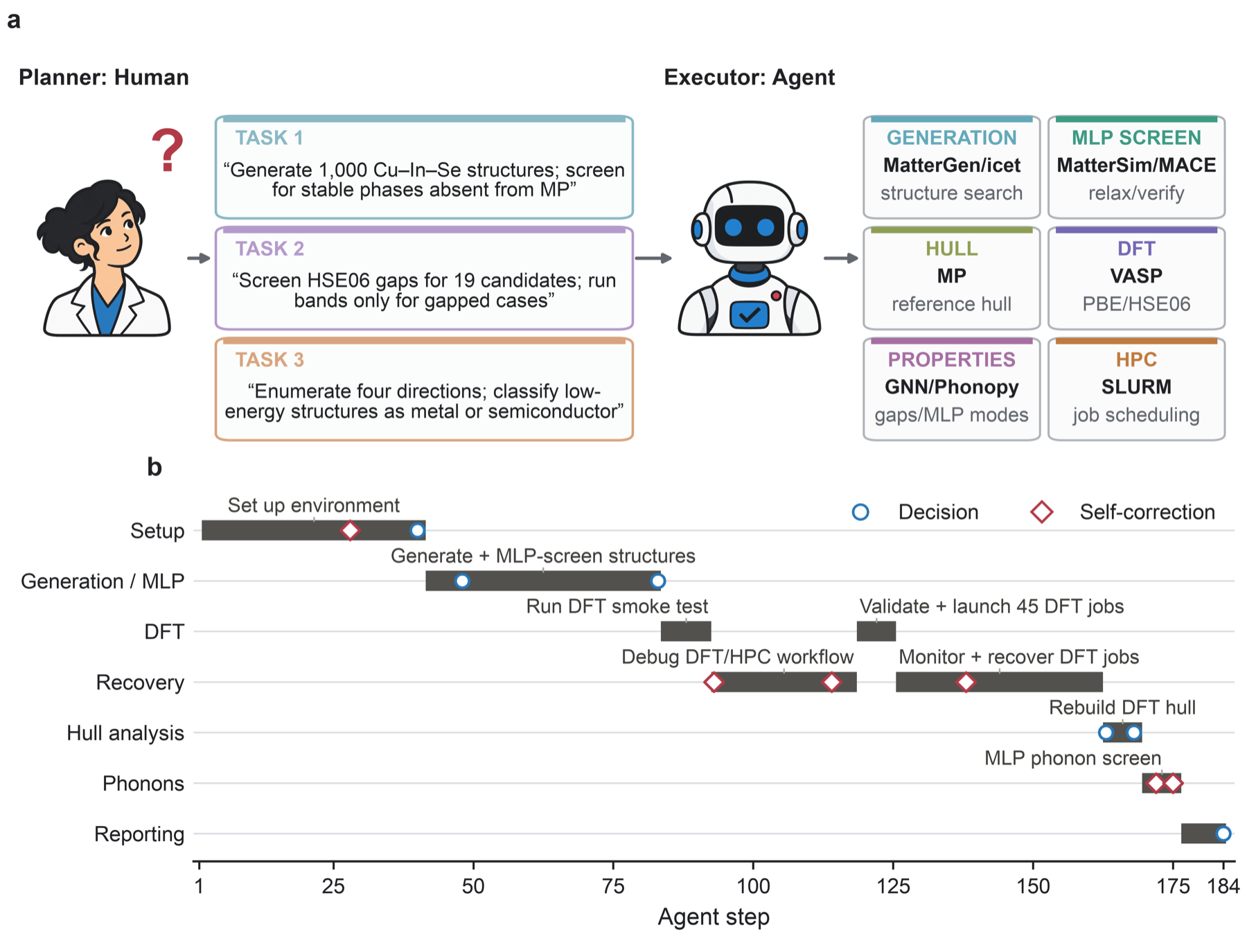
Humans define the scientific tasks, and an autonomous LLM agent carries out the calculations. We apply this workflow to Cu-In-Se, the system of the solar absorber CuInSe2, and search for low-energy structures on both the Cu-rich and the Cu-poor side. The search reveals an electronic asymmetry between the two sides.
Department of Materials Science and NanoEngineering, Rice University
* These authors contributed equally.
01 / Workflow
Humans define the tasks. The agent connects the methods.
The agent joins structure generation with MatterGen and icet, machine-learning potentials, DFT with VASP, phonon calculations with Phonopy and a band-gap model. It writes the Python that connects them and runs the jobs on a supercomputer.
From a single request, the agent completed the first task in 183 steps with no further human input. The authors reviewed the scientific validity of the outputs and extended the checks where the automated runs were incomplete.
 View full-size figure ↗
02 / Screening
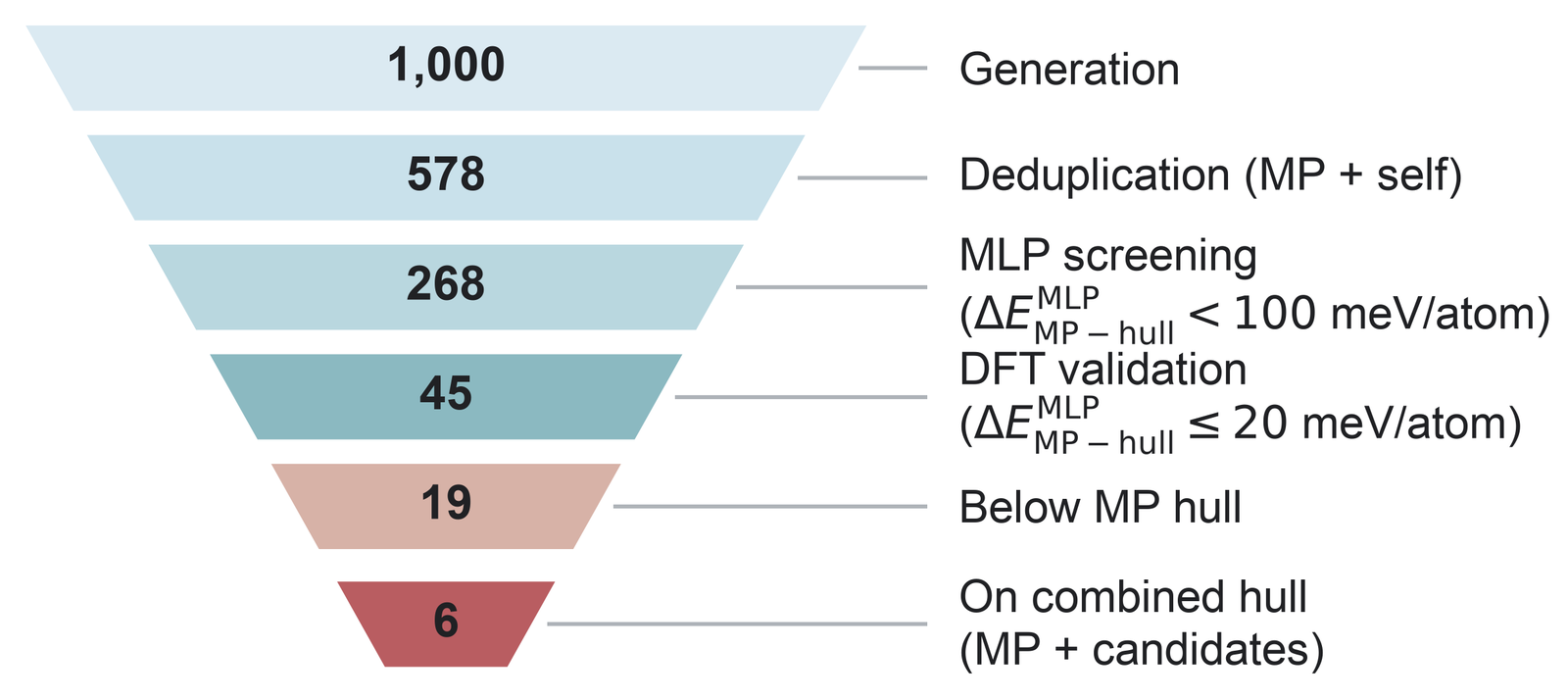
From 1,000 generated structures to 45 DFT-validated candidates.
The first task screens generated structures through deduplication, a machine-learning potential, and DFT. Of the 45 DFT-validated candidates, 19 lie at or below the Materials Project hull. Six remain on the hull built from the Materials Project entries and all 45 candidates.
 View full-size figure ↗
03 / Electronic structure
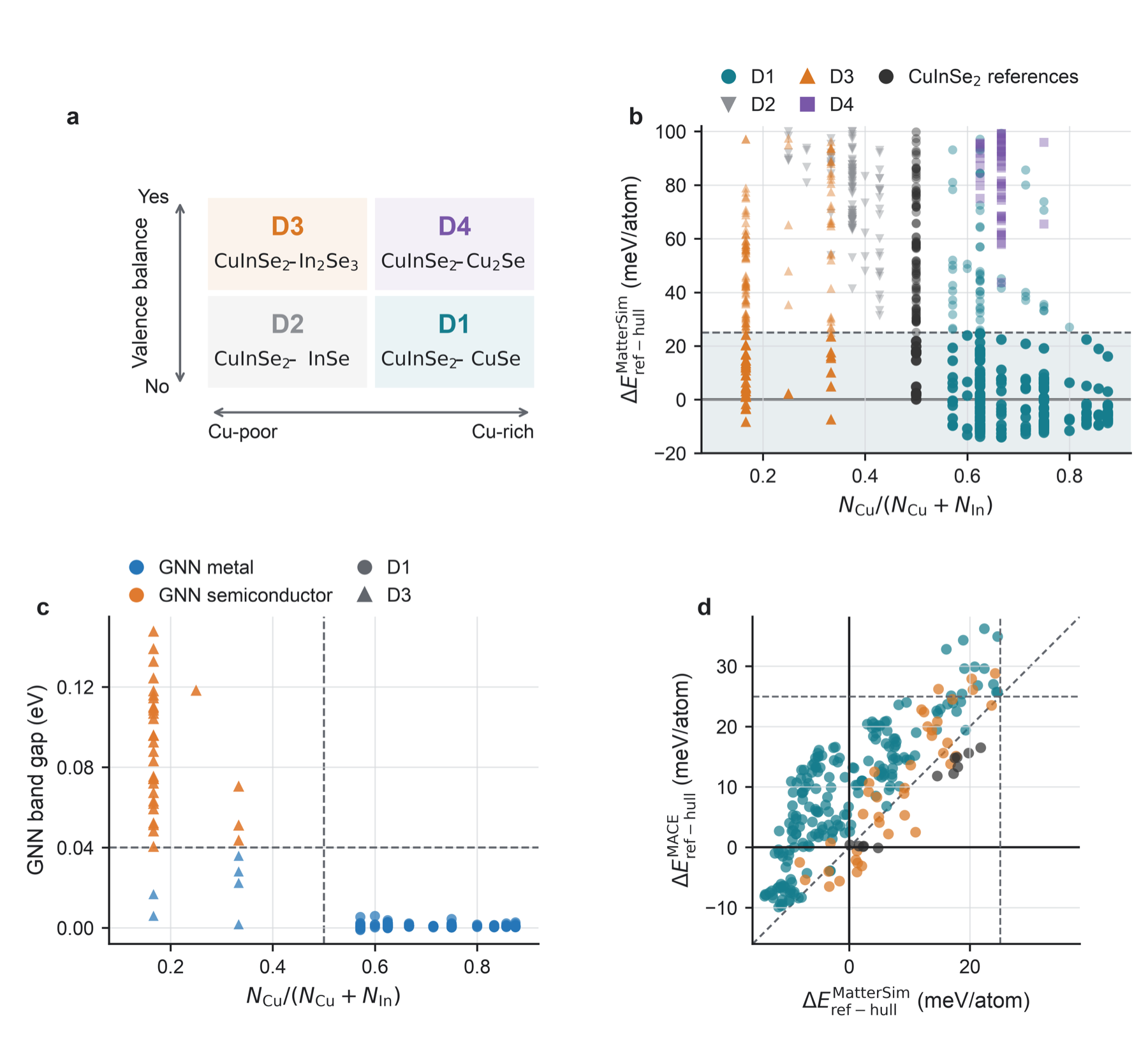
The search reveals an electronic asymmetry in Cu–In–Se.
Within 25 meV per atom of the reference hull, the Cu-rich side holds 202 structures, all classified as metallic, and 198 of them have no match in the Materials Project, OQMD, Alexandria or GNoME. The Cu-poor side holds 40, including 34 semiconductor candidates.
 View full-size figure ↗
Research paper
Off-stoichiometric energetic and electronic asymmetry in ternary Cu-In-Se: task-oriented materials discovery by an autonomous LLM agent
Zhenkun Yuan* and Chenmu Zhang*
Department of Materials Science and NanoEngineering, Rice University
* These authors contributed equally.